The Jakarta Post, 31 July 2021
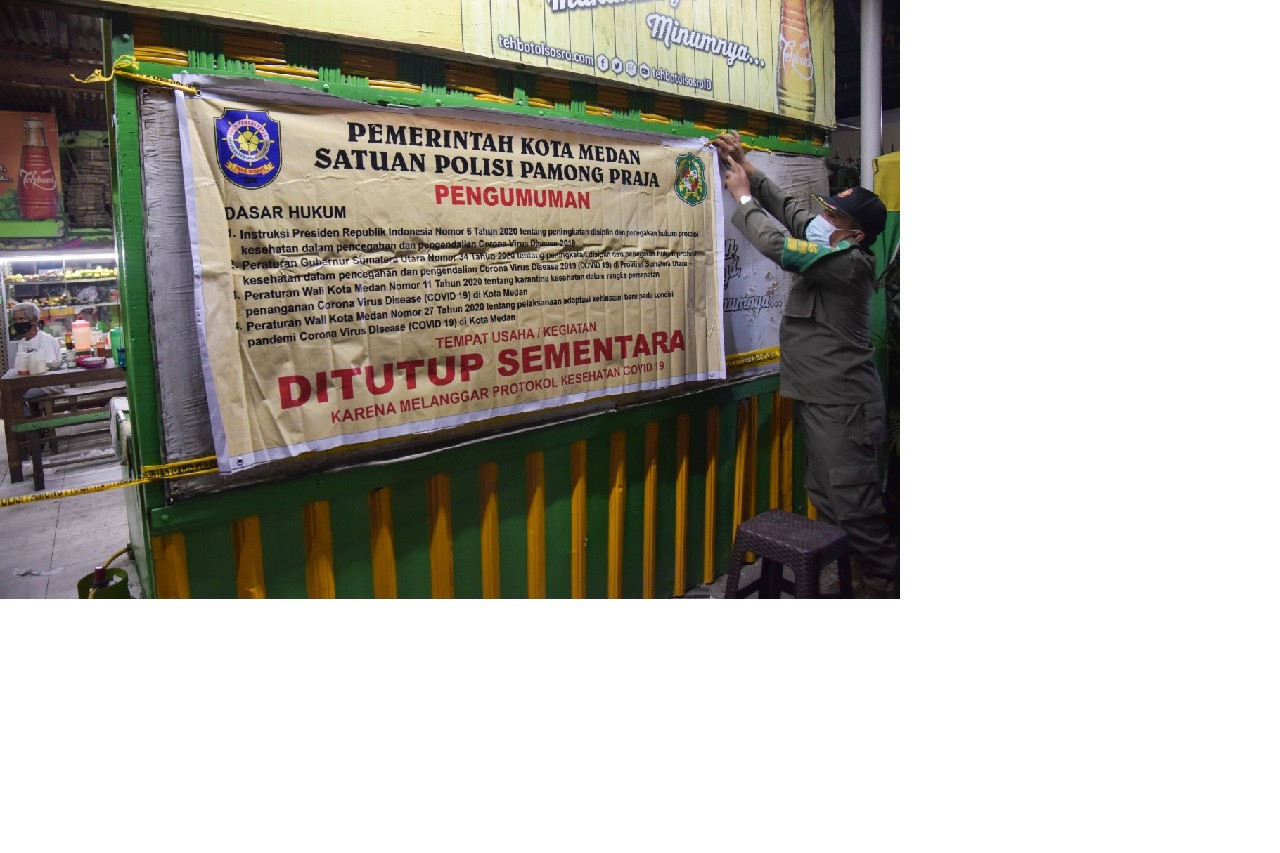
I and many other small-scale entrepreneurs were saddened to see the raids on small food stalls during the implementation of emergency public activity restrictions (PPKM Darurat) to curb the COVID-19 infection rate in densely populated Java and Bali.
Hopefully, the PPKM level 4 now in force until Aug. 2 will no longer involve such use of violence against people affected by the crisis in the name of enforcement of the regulation.
Read more: During pandemic government not an ad hoc committeeIn Surabaya, East Java; in Bandar Lampung; in Gowa, South Sulawesi, and other cities in the country, joint forces conducted the raids, in some cases involving acts of violence.
It is not only the potential use of violence that matters. The PPKM level 4 have only added problems for us small food stall owners for several reasons.
First, the regulation that customers may only stay at food stalls for 20 minutes. This could give public order officers justification to use excessive force to control food stalls and customers. It is not clear enough how we, or the officers, can make sure visitors follow the time limit. Will they, or we, sound an alarm any time someone stays over the limit?
Practically, for low-income people who are our loyal customers, the time they stay in food stalls is not spent only eating meals, but also releasing the stress of the day. Besides, should public order or police officers check that all food stalls enforce this protocol? Second, as a breakdown of the central government’s rule, the Jakarta government has issued a new regulation stipulating that vaccination is now mandatory for food stall customers, servants and owners, as well as street vendors and hawker stalls. Dine-in visitors are limited to half the capacity of the establishment.
For me, those regulations do not reflect a decision to implement policies favoring the poor, as those politicians had promised during their electoral campaign.
Jakarta Deputy Governor Ahmad Riza Patria said that during the implementation of the large-scale social restrictions (PSBB) in April 2020 until the PPKM Darurat on July 12, 2021, public order officers collected Rp 7.2 billion (US$500,000) in fines from health protocol violators.
It seems easy for government officers to fine and commit violence against those who break the rules. Citizens, however, do not want the taxes they pay to be spent on the salaries of the state apparatus, who oppress the weak like thugs.
For warteg (Tegal food stall) owners like me, raids and arbitrary enforcement of the regulations are not the only threats we face. Just last week the prices of some basic commodities went up. In the Kebayoran Lama traditional market in South Jakarta, for example, red chili prices skyrocketed from Rp 22,000 to Rp 35,000 per kilogram. The same happened to vegetable prices.
Every year, I spend Rp 30 million on the kiosk rental. I pay each employee Rp 1.5 million per month. Now business is slow. Since the beginning of the pandemic, at least 10,000 wartegs have had to quit the business since they could not afford to pay the kiosk rent and employee wages.
Sadly, in such a difficult time, raids are the norm, as if there are no other more humane choices. In fact, such measures have always been useless. Repression will be counterproductive, even in the pre-pandemic era. Instead the government should empower food stall owners and other small-scale businesspeople to ensure their survival.
In a normal situation, it is better to teach people to fish rather than give them fish. But, in a state of emergency, we cannot choose either of them. To spare people from starvation, fish and long-term solutions are needed to keep them alive.
At a warteg, a box of rice with simple side dishes such as fish, vegetables and tempeh, for example, costs Rp 15,000. With a simple calculation, it would be great if the Jakarta government allocates, let say, Rp 7.2 billion per month to buy approximately 500,000 meal boxes for people in need, including those who are self-isolating to recover from COVID-19 in shelters or at home. The meals can also be given to those enforcing mobility curbs.
In doing so, not only will warteg owners and employees survive and continue their business without fearing about raids. The public order, police and military officers will be able to enforce the rules easily and without having to resort to violence.
We understand that PPKM are a way to break the chain of COVID-19 transmission. But, we should also think of those whose livelihood depends on this small business. There are not many options available to us.
On many occasions, the government has expressed an intention to find the best solutions for all. But, the goodwill should be translated into actions. Nothing will change if the government acts as an ad hoc committee by providing cash transfers (BLT) and other forms of social assistance.
Both the central government and other local governments should learn from Madiun city, East Java. Since April 2020, Maidi, the mayor, has taken a pro-street vendor policy. He and government officials in Madiun empowered street vendors by buying meals from them for people in self-isolation at home.
Another example is the mayor of Lubuklinggau in South Sumatra, SN Prana Putra Sohe, who always reminded public order officers to control the crowd, not traders, during the PPKM Darurat. He emphasized that the local government did not want to prohibit them from running their business. All that matters is preventing the crowds as it will accelerate the spread of COVID-19.
Prominent economist Hernando de Soto, in his book Mystery of Capital, writes that the international poverty draws attention away from the arduous achievements of those small entrepreneurs who have triumphed over every imaginable obstacle to create a greater part of the wealth of their society. “I resent the characterization of such heroic entrepreneurs as contributors to the problem of global poverty. They are not the problem. They are the solution,” he says.
If de Soto were here in Indonesia, and talked to our government officers, what would be their response?
*** The writer owns a small food stall in West Jakarta.
 Frans Pascaries
Leave a comment