Frans Pascaries
The Jakarta Post, 8 December 2021
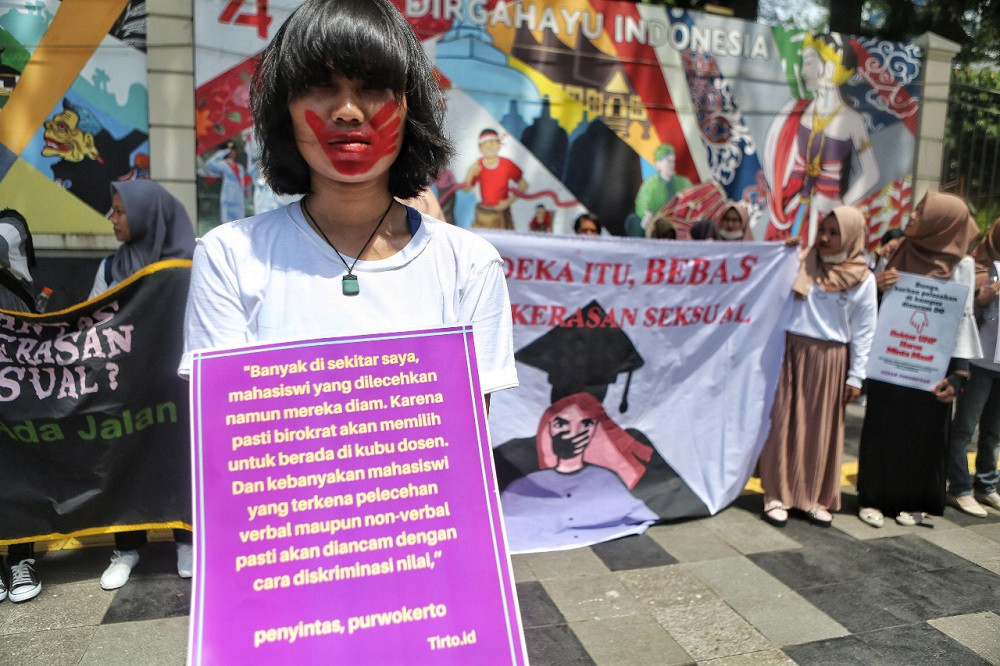
Photo caption: What women want: Students and activists from the Antiviolence Women Movement (GERAK) participate in a rally outside the Education, Culture, Research and Technology Ministry in Jakarta on Feb. 10 to demand deliberation of the sexual violence bill. (JP/Seto Wardhana)
A woman wrote an open letter to Education, Culture, Research and Technology Minister Nadiem Makarim last month. Without disclosing her identity, the sender, who teaches at the School of Social Sciences in a state university, says she had been assaulted verbally and sexually in her workplace.
She posted the letter in response to a ministerial decree on the prevention and treatment of sexual violence in higher education that became effective on Aug. 30.
She is not, of course, the only, nor the first woman in the country who has experienced sexual harassment on a daily basis for years. Most recently a student in the East Java city of Mojokerto reportedly committed suicide after admitting on her social media account to having been raped by her police officer boyfriend, who forced her to have an abortion twice.
Andy Yentriyani of the National Commission on Violence Against Women (Komnas Perempuan) said the known cases of violence against women were just the tip of the iceberg. Although many have had the courage to file reports with the commission, a Komnas Perempuan survey found 80 percent of victims were reluctant or did not know where to file reports.
The education ministry’s own study last year disclosed that 77 percent of professors surveyed believed sexual violence occurred on campus, but 63 percent of them did not report the cases to campus authorities.
Unsurprisingly, the ministerial regulation has been met with staunch opposition, particularly from conservative religious groups who accuse the policy of promoting and legalizing free sex as it cites a lack of consent from victims as a key factor that defines sexual violence.
The heated debate saw academic and prize-winning novelist Okky Madasari receive threats and online abuse after she explained why consent mattered and why Indonesians who have learned religion since childhood should not fear the regulation.
Those who are against the regulation may be unaware that they themselves, their children, relatives or friends could fall prey to sexual abuse – online or offline. Reports have shown sexual abuse cases have increased worldwide during the COVID-19 pandemic.
The challenges to the ministerial regulation and the long-overdue deliberation of the sexual violence eradication bill at the House of Representatives in particular, and the long and winding road to eliminating sexual violence in the country in general, only prove the deep-seated culture of misogyny in our society. This kind of society provides impunity to perpetrators and stigmatizes victims.
We can draft a regulation or a bill intended to combat sexual violence, but we should not forget those who formulate the policies do not stay in “empty” rooms. Most of the policymakers, if not all, come from a society that for so many years has embraced conservative values, including misogyny. The House Legislation Body’s decision to drop any words supporting the concept of sexual consent in its debate on the sexual violence eradication bill confirms this.
From Nov. 25 to Dec. 10 the world observes the International Day for the Elimination of Violence against Women through 16 days of activism. This year the United Nations Entity for Gender Equality and the Empowerment of Women (UN Women) chose “Orange the world: end violence against women now!” as the theme, while in Indonesia the theme is #GerakBersama (#MoveTogether) and “Voice out: pass the sexual violence eradication bill in favor of the victims”. Hopes still abound that the final draft of the sexual violence eradication bill the House passes will side with the victims.
Everyone who cares about the future of their children should pay more attention to this issue and do everything possible, no matter small or big, to create a world that is free from any form of violence, and to spare them from the risks of sexual abuse.
I am going to share the nation’s battle against sexual violence with my daughter when she grows up and will encourage her to join the fight. I will also learn together with her how to treat others, especially women, with dignity.
Hopefully, she and other girls and women of the next generations can someday find that misogyny has become history. Yes, it is still a long fight to end violence against women.
*** The writer is the father of a daughter, a freelance writer and translator of the book Esclavas del poder about the sex slavery of women and girls in several countries, authored by prominent Mexican journalist Lydia Cacho into Indonesian. Published by Marjin Kiri in 2021.
 Frans Pascaries
Leave a comment